What Is Link Building in SEO?
What is a link?
Simply put, a link, or a hyperlink, is a connection between two pages on the internet. With a link, you can refer people to a page, post, image, or another online object. Links exist for people in the first place: with a link, you can easily “travel” from one web location to another.
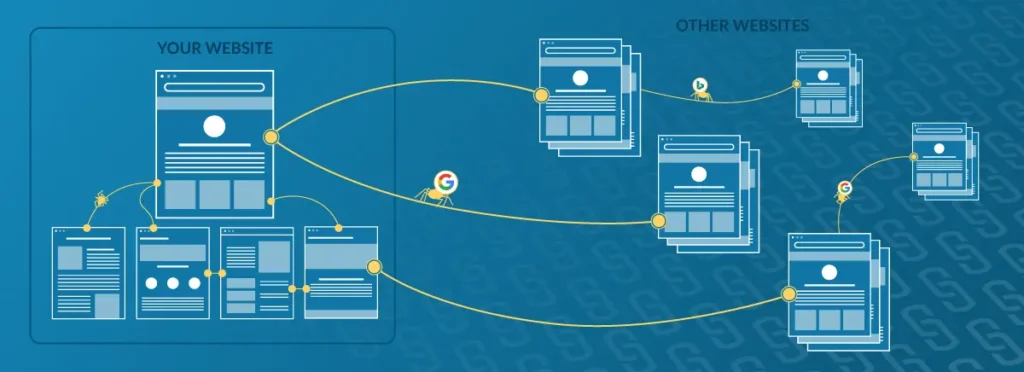
But links serve search engines too – search engine robots follow links to discover pages on the internet. This is called crawling. For a robot to find your website, you’ll need at least one link to it from another website that was crawled already. Making sure you get that first link is one of the things you need to do when you launch a brand new website.
A link in HTML
In the coding language HTML, a hyperlink looks like this:
<a
href=”https://yoast.com/wordpress/plugins/seo/”>Yoast SEO plugin for
WordPress.admin
The first part contains the URL you’re linking to. In this case, it’s the URL of the Yoast SEO plugin page (https://yoast.com/wordpress/plugins/seo/). The second part (Yoast SEO plugin for WordPress) shows the clickable text that you’d see on the page. We call this piece of text the ‘anchor text’.
Internal and external links
There are two kinds of links that matter for SEO: internal links and external links.
Internal links are links on your website connecting your various pages together.
External links, otherwise known as incoming links, are links that other people place on their websites to refer their users to your pages (or the other way around). People working in the SEO industry describe these external links as ‘backlinks’. If other websites link to your pages, you’re getting backlinks from them. On the other hand, you’re giving them backlinks if you link from your pages to theirs.
Internal linking isn’t the same thing as link building. In this post about link building, we’re only looking at the process of getting other websites to link to your pages. Also known as getting ‘backlinks’ from other websites.
Anchor text
The anchor text serves two purposes: it should describe what the linked page is about and entice people to click. A link with a well-crafted anchor text has two advantages:
- more people click on it, leading to more direct traffic, and
- it will help search engines understand what your page is about, possibly leading to more traffic from search engines.
Of course, you can’t control the anchor text used when others link to your site. But you can use anchor text to improve your own internal links.
What is link building, and why do we build links?
Link building refers to the marketing efforts to get links from other websites to your website. It’s seen as one of the most powerful tools to achieve higher rankings in search engines. Google’s Andrey Lipattsev even confirmed in a Q&A session that backlink is an important ranking factor.
This makes sense when you think about it. If a page gets a lot of high-quality backlinks, it should/must be a good page. Therefore, search engines will consider it a popular or meaningful page, and they’ll rank it higher.
It’s good to realize that not all backlinks are equal in value. Next to that, since getting links from external websites is a strong ranking factor, it creates an issue for the SEO industry. That is: websites would try shady link building techniques to get more backlinks.
Link quality
Links aren’t all equal. Some links are way more valuable than others. For instance, a link from an authoritative website, preferably topically related to yours, is worth more than a random link from a small website nobody knows.
Let’s say, if you have a restaurant, you’d rather get a link from a restaurant review (on topic) on The Guardian website (high authority), than a link from your aunt’s horseback-riding school website. This makes choosing sites you’d love to get links from easier. But at the same time, it makes it a lot harder to get those coveted high-quality links.
Shady techniques
Because link building isn’t easy, lots of shady link building methods emerged in the past. People tried to game the system, for instance, by buying links from link farms. That’s why link building has got a somewhat nasty reputation.
Consequently, Google intervened with serious penalties as a result. If a page gets lots of backlinks from websites with a questionable reputation, it can completely disappear from the search results. So you’re better off avoiding these risky link building tricks. If you play it fair and smart though, you can gain a lot from link building.
What should you do to get links?
Now we get to the million-dollar question: what should you do to get those valuable links?
We believe in a holistic link building approach. You’ll have to create a website that people want to link to. It sounds so simple: Create high-quality, funny, original, or exceptional content people want to share. But how do you do this?
First and foremost, find out who your audience is. Who are you trying to reach with your content? Then, think about what kind of content they need. What information are they looking for and what kind of questions do they ask? Which words do they use? And, what kind of websites do they visit?
If you can answer these questions, it will be easier to create content that fits your audience’s needs for instance, by using the principles of content design. Also, when you’ve created that page with valuable content for your audience, and you know which websites they visit, you’ll have a starting point for your link building activities. That is: you can start reaching out to those website owners.
That’s what link building is, in a nutshell. It’s about reaching out to other parties and sharing your article with those that might be interested in sharing it too. That’s why it’s key to target the right niche. This help to decrease the number of people you’ll have to contact and increases your chances of actually getting a link.
People will only link from their website to yours if it’s in their audience’s (or their own) interest. Convincing them to link will only happen if your product or content really is exceptional. Offering to let them try or use your product (if you have one) for free might help convince them. And always make sure to contact them personally, as this will lead to better results. Read all about this process in our step by step guide to link building.
Link building for pros
Have you got the basics about link building and want to take it a step further? Then we’d advise you to read this article with advanced link building tips by Kris Jones. You’ll learn which tools you can use to find out which sites already link to you and what you can do to get more of those. Find out everything about broken link building, reclamation link building, the so-called skyscraper technique, and more.
if reaching out really isn’t your thing, you can always start with some “internal link building”: fix your internal linking structure! But ideally, you should work on both internal linking and link building to improve your site’s SEO.
Within SEO, link building plays an important role in driving organic traffic via search engines, especially in competitive industries. When combined with strong technical SEO foundations, great on-page SEO, excellent content, and a good user experience, link building can be super effective at driving more organic traffic.
Today, the need for quality, relevance, and authenticity has never been more important. While low-quality, spammy link building techniques can work, they shouldn’t play a part in a strategy for an organization who is building for long-term organic search success.
Arguably, link building these days is more akin to great marketing, and the organizations who understand this are usually the ones who win long-term. But that doesn’t mean that there isn’t a technical aspect to building links or that all techniques need to revolve around your product. We’ll see that there's still far more to it than this, and far more to understand than ever before.
This guide is designed to get you going quickly, and in the right direction. There's a lot to take in, but we've broken everything up into easy-to-digest chapters and have included lots of examples along the way.
The definition of link building
Link building is the process of acquiring hyperlinks from other websites to your own. A hyperlink (usually just called a link) is a way for users to navigate between pages on the Internet. Search engines use links to crawl the web. They will crawl the links between the individual pages on your website, and they will crawl the links between entire websites.
Not all links are deliberately built by SEOs or marketers. Many of them will be created for a range of reasons such as a journalist covering a news story and linking to a source, or a blogger who loves their new coffee machine so much that they link to the retailer who sold it to them. Acquiring links that you didn’t ask for is the nirvana of SEO. It's always something that you should be striving for and building towards over the long term. You do this by putting in the work to make your website link-worthy, whether that’s through a great product or aspect of your service, or via producing great content that is referenced by other websites.
Alongside this long-term approach, you can also leverage a range of link building techniques which allow you to build your authority and increase your chances of ranking well and getting traffic from organic search.