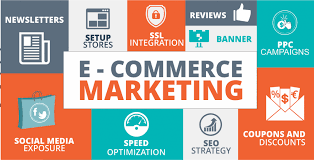
What is E-Commerce Marketing?
E-commerce marketing is the process of driving awareness and traffic to an online store and converting website visitors into loyal customers. When done correctly, e-commerce marketing and advertising can help online retailers and service providers realize considerable ROI and reach business goals.
Types of E-Commerce Marketing Channels
E-commerce marketers can leverage a number of advertising channels including web, social, email, and search to attract visitors and guide purchasing decisions. Below, we outline the most lucrative e-commerce marketing channels and how you can use them to attract buyers to your online store:
1. Content marketing
The most basic form of inbound marketing, content marketing, helps generate leads, build your brand, and drive more customers to your online store. Through the use of written articles, visual, and video content, online businesses can prove value to their customers and appeal to customer needs through personalized online experiences. The key is to engage users and build trust so that your customers come back again to make repeat purchases. Be sure to leverage customer data and understand your target audience when creating web content.
2. Social media marketing
Social buying is on the rise. Smart e-commerce marketers are leveraging social platforms like Facebook, TikTok and Instagram to advertise products, gain customer feedback, and even sell products in-app. Research shows that 43% of shoppers research products on social media prior to making a purchase, and most online shoppers believe that social platforms benefit their purchasing decisions. Further, online retailers with at least one social media account generate an average of 32% more sales than online retailers without social media. Certainly, social media marketing should be a no-brainer for modern e-commerce businesses.
3. Email marketing
Email marketing is a great way to generate sales for your online store. From abandoned cart emails to intricate and personalized campaigns, email works to build relationships with customers. Think about the way you’re pushing promotions, coupons, and lead nurturing emails. Leverage segmentation and avoid the all-too-passé email blast. Your bottom line will thank you later.
4. Mobile marketing
Since 2018, mobile traffic has represented the majority of global web traffic. Today, online shoppers are making more purchases via their mobile device than on their PC, and around 51% of all shoppers purchase items using their smartphones.
Mobile marketing isn’t just about your app either — it’s about optimizing your e-commerce site for mobile users and connecting SMS, email, and social to your mobile marketing efforts. This level of interconnection is vital in an increasingly mobile-first world.
5. Search Engine Optimization (SEO)
SEO plays a crucial role in driving organic traffic to e-commerce sites by improving visibility on search engines like Google and Bing. Optimizing your product pages and on-site content helps ensure that potential customers can find you when they’re in the market for your products.
To enhance SEO for e-commerce:
- Optimize product pages with targeted keywords, engaging product descriptions, and high-quality images.
- Use descriptive meta tags and ensure your URLs are concise and include keywords.
- Prioritize mobile optimization to enhance page speed and the user experience.
- Regularly update content and create valuable blog posts that incorporate relevant keywords to attract organic traffic.
A solid SEO strategy can lead to more qualified visitors and higher conversion rates, making it an essential channel for e-commerce marketing.
6. Pay-Per-Click (PPC) advertising
Looking to quickly increase traffic to your product pages and drive extra conversions? PPC could be a solid strategy. PPC advertising is a highly effective way for e-commerce businesses to attract targeted traffic by paying for clicks on ads shown in search engines or social media platforms. In PPC campaigns, you bid on keywords relevant to your products, and your ads appear when users search for those terms.
To create effective PPC campaigns:
- Conduct keyword research to identify the most relevant and cost-effective keywords for your products.
- Use targeted ad copy that highlights key product features and incorporates compelling calls-to-action.
- Continuously optimize your bids and monitor performance metrics to ensure a positive return on ad spend (ROAS).
When managed properly, PPC can drive qualified traffic and lead to increased sales. In fact, Nike used Emarsys to achieve an incredible 11x ROAS, as part of their omnichannel e-commerce strategy.
7. Influencer marketing
Influencer marketing involves partnering with social media influencers to promote your products to their engaged audiences. This relies on leveraging influencers’ credibility and reach, e-commerce brands can build trust with potential customers and drive traffic and sales.
To create successful influencer partnerships:
- Choose influencers whose audience aligns with your target demographic and whose values resonate with your brand.
- Provide influencers with creative freedom to authentically showcase your products in a way that feels natural to their followers. However, it’s important to provide them with brand guidelines and, where applicable, some loose information on product uses and benefits.
- Track performance by using unique discount codes or affiliate links to measure conversions and engagement.
By advocating for your brand, influencers cultivate trust between their audience and your products. These referred customers are pre-programmed to be loyal, since someone they trust has already vouched for your brand.
8. Omnichannel marketing
Omnichannel marketing is a cross-channel strategy used to drive a unified customer experience across all possible channels and touchpoints including both traditional and digital channels.
According to SocialMediaToday, customers’ preference for omnichannel marketing campaigns increased by 14.8%. Additionally, marketers using three or more channels in any one campaign earned a 287% higher purchase rate and earned a 90% higher customer retention rate than those using a single channel campaign.